general
Patagonia Jacket Links: Spreadsheet or Google Sheets
# Patagonia Jacket Links: Spreadsheet or Google Sheets If you're organizing [Patagonia](https://fashion-reps.net/brand/patagonia) winter jacket candidates, the real issue isn't which spreadsheet tool is more popular, but whether you can reliably do these things: find candidates, open product pages, confirm links still work, record specs and prices, and decide if page info needs re-verification. This article covers one specific task: turning the Patagonia winter jacket candidates from the fashion
If you're organizing Patagonia winter jacket candidates, the real issue isn't which spreadsheet tool is more popular, but whether you can reliably do these things: find candidates, open product pages, confirm links still work, record specs and prices, and decide if page info needs re-verification.
This article covers one specific task: turning the Patagonia winter jacket candidates from the fashion-reps site-style catalog into a reviewable list and using Google Sheets to track link status, product info, and update times. It's not for those who already have a full product database, need complex multi-user permissions, or want to scrape many pages automatically.
Verification date: October 8, 2026. Prices, product info, stock, page status, and external platform policies may change—always re-open the original product page before submitting candidates. 🧭

Clarify the Verification Task and Evidence Boundaries for Patagonia Winter Jacket Candidates
The goal is to produce a candidate list that can be re-checked, not to declare which jacket is 'best' or 'worth buying'. Each candidate needs at least the following evidence:
- The candidate can be located in the site-style spreadsheet.
- The candidate card or product page shows a clear product name.
- The product link opens correctly, not a blank page, category page, or dead link.
- Record the currently visible price, style, color, fill info, or other specs.
- Record the verification date and mark which info is still unknown.
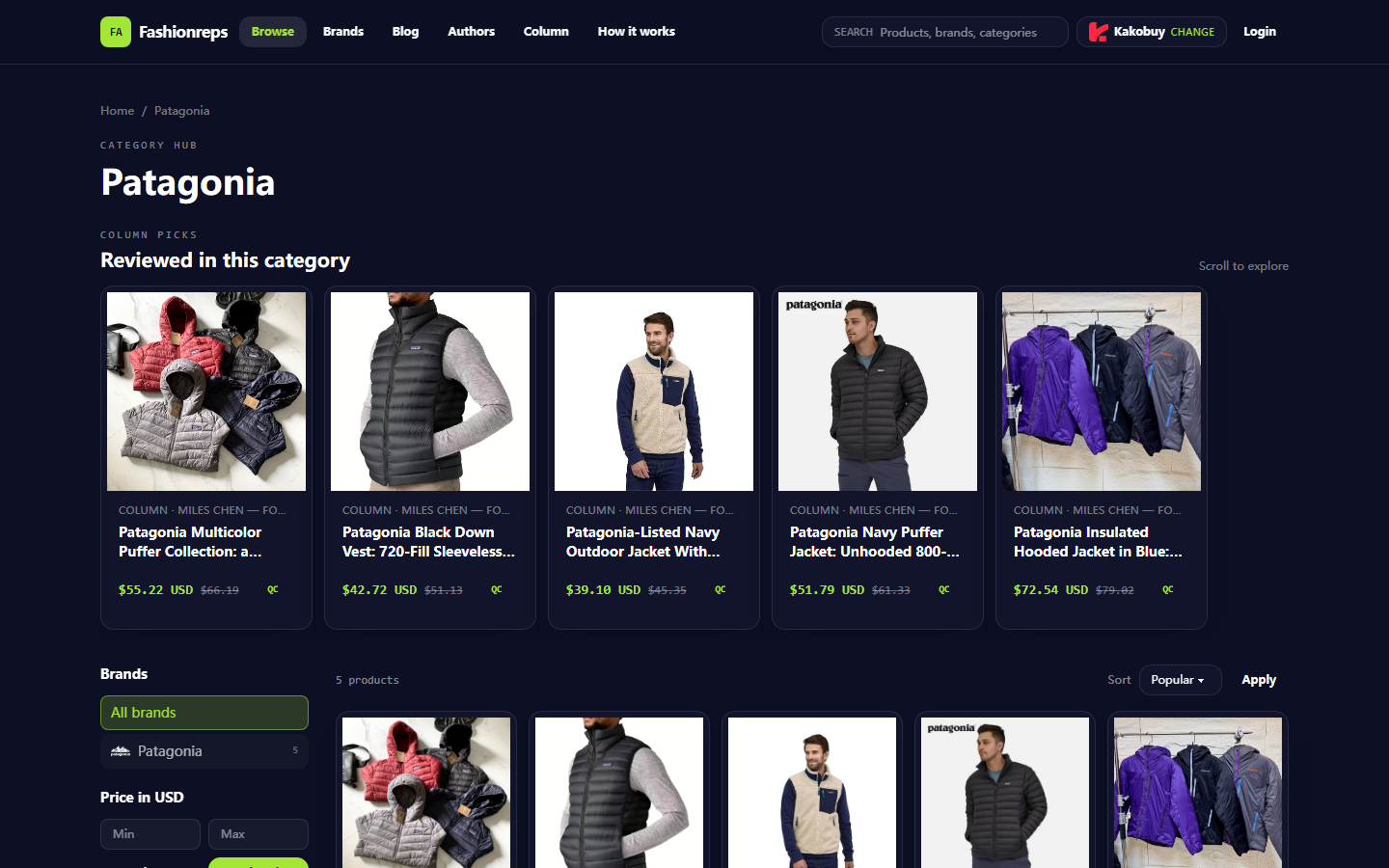
fashion-reps' Patagonia category page currently shows 5 candidates, with brand filter, price filter, sorting, and product cards. Visible candidates include a hooded 550-fill white duck down jacket, a 720-fill black down vest, a navy outdoor jacket with fleece surface, an 800-fill navy down jacket, and a blue lightweight synthetic insulated hooded jacket.
These names and reference prices are only for page verification records, not proof of ongoing stock, final price, or authenticity. Always open product pages separately to confirm color, size, material, seller info, and current link status.
Evidence boundaries matter here too: the site-style spreadsheet helps you discover and browse candidates, but can't prove product quality; Google Sheets helps you record and collaborate, but can't replace product page checks; 'confirmed' in a table only means a piece of info was seen on a specific date, not that it won't change later.
How to Locate Candidates and Open Product Pages in the Target Site's Spreadsheet
On fashion-reps' Patagonia category page, first narrow down candidates by brand and category range, then go through each product card. The current visible page structure includes:
- Patagonia category entry.
- Product cards and editorial perspective notes.
- Reference price and previous reference price.
- QC badge.
- Price filter and sorting options.
- Product detail page entry.
Recommended order of operations:
- Open the Patagonia category page—don't judge product existence from search engine snippets.
- Confirm the page title and category range actually correspond to winter jackets or related insulated items.
- Record candidate names first, then open product pages.
- On the product page, check for a clear product name, visible specs, and a valid purchase entry.
- Copy the product page URL into your record sheet, not just the category page URL.
- Record the open date and mark any redirects, empty content, or login restrictions.
The site-style spreadsheet's advantage is a short discovery path: browse by brand, filter by price or sorting, then enter detail pages from candidate cards. It's better for initial discovery and scenarios where you need to reference categories, images, editorial notes, and QC entries simultaneously.
But it shouldn't be treated as a complete archive. Reference prices on category pages may differ from product detail pages, and short descriptions on cards may not cover sizes, colors, sellers, stock, and return conditions. So after candidates enter your list, you must go back to product pages and confirm item by item. 🔎
How to Record Links, Specs, and Page Update Times in Google Sheets
Google Sheets is better for organizing already-discovered candidates. It's recommended to have one row per product page and one column per distinct field, avoiding mixing multiple facts into one notes cell.
| Field | How to Record | Key Check |
|---|---|---|
| Product Name | Copy the currently visible name from the product page | Don't substitute with your own guessed abbreviation |
| Product Page Link | Save the product detail page URL | After opening, confirm it's not a category page, redirect, or dead page |
| Page Status | Valid, redirect, dead, login required, insufficient info | Base on actual open result |
| Price and Currency | Record the displayed amount and currency | Don't treat reference price as final price |
| Spec Summary | Color, fill, fit, size, etc. | Write 'Not displayed' for missing info |
| Page Verification Date | Use a specific date | Overwrite or add new record after re-verification |
| Next Step | To confirm, add to candidate, exclude | Write the next action clearly |
Google Sheets' value isn't re-displaying products from the site-style spreadsheet, but establishing consistent verification records. You can filter for 'Page status: Valid' candidates or sort by verification date to find old records needing re-opening.
For link status, don't just write 'good' or 'bad'. 'Valid' means the page opens and has enough info to support next steps; 'Insufficient info' means the page opens but lacks key fields; 'Redirect' means the original URL automatically goes to another page; 'Dead' means inaccessible or a clear error; 'Login required' means you can't verify full info with current permissions.
Update time should be split into two concepts: page verification date and page's own update time. The former is the date you actually opened and checked, the latter is only recorded if the product page explicitly shows it. If the page doesn't show a publish or update time, write 'Page doesn't display', and don't infer from URL, price changes, or your own edit time. 📅
Compare Link Status and Product Info for the Same Candidate Item by Item
After initial recording, don't immediately mark all candidates as 'purchasable'. Do a side-by-side comparison from catalog to product page for each candidate:
- Do the category page name and product page name refer to the same item?
- Is the reference price on the category page consistent with the current price on the product page?
- Are there conflicts in color, fill type, hood design, and fit description?
- Does the product page still have a clear purchase entry?
- Does the link open to the correct product, not the brand homepage or another product?
- Are sizes, stock, and seller info visible on the page?
- Do the images belong to the product, and are there any loading failures or mismatches with the name?
If the category page says 550-fill but the product page has no fill info, don't fill it in yourself; record 'Category page shows, product page doesn't display' and put the candidate in pending review. Similarly, if a product shows 'previous reference price', it only means the page displays a historical reference amount, not that the current discount is truly valid.
If candidates involve external shopping agents, separate product evidence from agent service info beyond the product page. Agents typically involve product fees, domestic China shipping, international shipping, and customs-related fees, but these depend on weight, route, destination, and service conditions. Don't confuse the reference price on the site's product page with the final landed cost.
QC photos also can't replace product page facts. QC images are mainly for checking quantity, color, size labels, style, and appearance; sealed packaging products may have restrictions on inspection without opening. If you don't see something, keep 'unverified' instead of writing missing evidence as passed. 🧥
Operational Differences: Mobile Quick Browsing vs Desktop Deep Organization
Mobile is good for quick discovery and initial screening:
- Open the Patagonia category page.
- View candidate images and names.
- Use brand, price, or sorting to narrow down.
- Open product pages and confirm links aren't obviously dead.
- Add candidates to a pending list.
Mobile isn't good for lengthy multi-field comparisons. Page redirects, copying long links, viewing category and product pages simultaneously, and recording multiple specs can lead to missing verification dates or mixing info from different candidates.
Desktop is better for deep organization:
- Open the site-style spreadsheet or product catalog on the left.
- Open Google Sheets on the right.
- Copy product page links and currently visible fields one by one.
- Use filters to view dead links, missing info, and pending review records.
- Re-open key candidates before submission.
Neither device fully replaces the other. Mobile handles quick discovery, desktop handles structured recording; if you have very few candidates, mobile can do the whole process, but still keep clear page status and verification date.
How to Mark Dead Links, Missing Info, and Unknown Update Times
Don't delete dead links. Deleting destroys the candidate source and future re-check clues, especially when product pages are temporarily down, URLs change, or category pages still show cards.
Keep the original link and use these marks in the status column:
- Dead: Page won't open or shows a clear error.
- Redirect: Original link automatically goes to another page, and you can't confirm it's the same product.
- Insufficient info: Page opens, but lacks key specs to support a decision.
- Update time unknown: Page doesn't show a verifiable update time.
- Pending review: Page temporarily works, but volatile info like price, size, or stock needs re-confirmation.
'Update time unknown' doesn't mean the page is outdated or latest. It just means the page provides no verifiable update time. For volatile fields, re-open the page to update the verification date and note in comments which fields changed.
If product page and category page conflict, keep both original records and write the conflict in notes. Don't arbitrarily pick one number or description to make the table look tidy. The final candidate list can exclude unresolved conflict items, but should not erase the conflict itself.
Combined Workflow: Site-Style Spreadsheet + Google Sheets
A steadier workflow has four stages:
- Discover: Browse candidates on fashion-reps' site-style spreadsheet by Patagonia category, price, and sorting.
- Verify: Open each product page, confirm name, link, visible specs, and page status.
- Organize: Put each candidate into a separate row in Google Sheets, add verification date and unknown fields.
- Review: Re-open key candidates before submission, check links, prices, sizes, stock, and update time records.
This combination has clear division of labor. The site-style spreadsheet handles catalog navigation, image browsing, and candidate discovery; Google Sheets handles filtering, sorting, notes, collaboration, and review queues. Neither alone can prove product quality, stock stability, or final landed cost.
If you only use the site-style spreadsheet, common issue is fast discovery but insufficient historical verification records; if you only use Google Sheets, the table may look complete but lack original category and product page sources. When combining, always save product page links and record verification dates.
For lists handed to others for review, write 'Next step' as an action, like 'Re-open product page to confirm size', 'Wait for seller info supplement', 'Exclude redirect candidate', not just 'Attention' or 'Look again'. Then the next person can continue directly without guessing your reasoning. ✅
Final Pre-Submission Verification Checklist
Check row by row:
- Is there only one Patagonia candidate per row?
- Did you save the product detail page link, not just the category page?
- Has the link actually been opened?
- Does the page have a clear product name?
- Does the price include currency and note whether it's reference price or current page price?
- Do color, fill, fit, and size info come from visible page content?
- Are missing fields clearly marked 'Not displayed' or 'Unknown'?
- If page update time isn't shown, did you avoid inferring a date?
- Did you record this verification date: October 8, 2026, or the actual re-verification date?
- Are dead, redirect, and insufficient info candidates kept with status, not mislabeled as valid?
- Did you re-open key candidates before submission?
- Did you separate product price from international shipping, customs fees, and other service fees?
Ultimately, choosing site-style spreadsheet or Google Sheets depends on which step you're on: for discovering candidates, the site-style spreadsheet is more direct; for organizing links and update times, Google Sheets is more controllable. For most Patagonia winter jacket candidate lists, discovering in the site catalog first and then verifying item by item in Google Sheets is an easier-to-review approach.
This method is not recommended for heavy auto-scraping, real-time stock syncing, or replacing a formal product database. Links, prices, specs, stock, and platform policies may change—any candidate you plan to order should still be re-confirmed before actual purchase.
Agent Platform Shopping FAQ
1. What exactly are QC photos on kakobuy?
kakobuy maintains its own quality control staff for every order. When your purchased products reach the kakobuy warehouse, a quality check is performed and QC pictures are taken. Typically, three images are captured, and the staff confirms that color, dimensions, specifications, and count all align with your order. Any visible quality problems are also checked. Electronic goods are an exception where only the outer appearance is examined. If a defect or a mismatch in size or color is found, kakobuy immediately asks the seller for a return, ensuring you get items that meet expectations.
2. What should I do if I'm not happy with an item I received through kakobuy?
Get in touch with kakobuy customer service right away. Many non-specialty Chinese sellers offer a 5-day unconditional return and exchange window. If you're dissatisfied, you may ask for a return. Should the product already be shipped to you and you later find a quality issue, contact kakobuy customer service so they can liaise with the merchant to work out a compensation arrangement.
Below are the customer service email addresses for each platform:
kakobuy: service@kakobuy.com
oopbuy: support01@oopbuy.com
usfans: support@usfans.com
hipobuy: care@hipobuy.com
superbuy: care@superbuy.com
3. Why would I use a spreadsheet when shopping with kakobuy?
Since kakobuy doesn't display products directly on its site, you rely on a spreadsheet to locate links for items you want. An alternative is asking on Reddit or Discord, where suggested products are often great, though the process can be slow. These spreadsheets are usually built over months by collecting recommendations from those communities.