general
Rick Owens Shoes Review: Fit, Sizing, and QC Checks
Introduction When looking at [rick owens shoes](https://fashion-reps.net/shoes/rick-owens), the easiest thing to confuse isn't the look—it's the evidence: product photos help judge the overall silhouette, spec and size fields confirm the variant, and QC pictures only show visible condition at the time of shooting. These three types of information cannot replace one another. This article uses a Rick Owens dark high-top lace-up shoe from a [Fashionreps](https://fashion-reps.net/) page record as a
Introduction
When looking at rick owens shoes, the easiest thing to confuse isn't the look—it's the evidence: product photos help judge the overall silhouette, spec and size fields confirm the variant, and QC pictures only show visible condition at the time of shooting. These three types of information cannot replace one another.
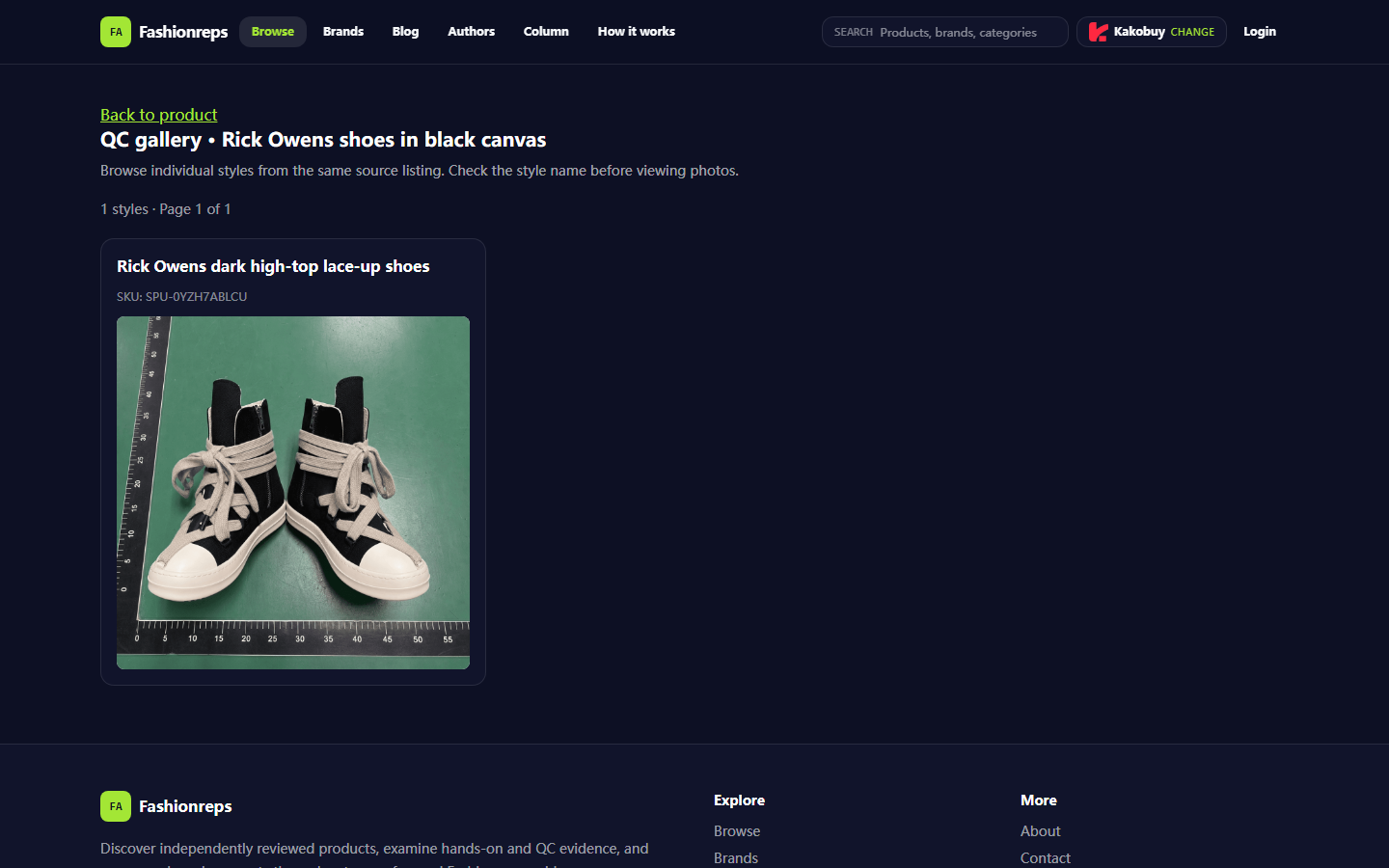
This article uses a Rick Owens dark high-top lace-up shoe from a Fashionreps page record as a sample to organize the checks you can do before ordering. The page record shows that the item is labeled as black canvas shoes, with SKU SPU-0YZH7ABLCU; the QC page also notes that the same source may contain multiple styles, so you should confirm the specific style before viewing images. 📌
Clarifying Sizing and Selection Issues in rick owens Shoe Reviews
The core question this time is: how can a buyer, without actually trying them on, separately judge whether the shoe shape meets expectations, whether the size information is sufficient, and whether the QC pictures truly support placing an order?
After reading, a buyer should be able to do three things:
- First confirm which specific style they're choosing, rather than ordering based only on the brand name or black look.
- Record the upper silhouette, sole structure, size fields, and visible QC issues separately.
- Know what to ask for when the size chart, variant info, or QC evidence is insufficient, instead of filling gaps with imagination.
This content does not apply to scenarios requiring authentication, long-term durability, real-world comfort, break-in period, or after-sales outcomes, because the current page record doesn't support those conclusions.
Defining Evidence Boundaries: Product Photos, Specs, Size Fields, and QC Images
Product photos are mainly for identifying the visual direction, including high-top silhouette, upper color, lace layout, and approximate sole proportions. They alone cannot prove material composition, internal structure, sole hardness, or actual sizing.
Spec fields serve identification purposes, such as product name, SKU, color, style, and available variants. The current sample page record is "Rick Owens dark high-top lace-up shoes" and shows info related to black canvas shoes. Black canvas is the product description in the page record; you should not infer specific fabric weight, abrasion resistance, or waterproofing from it.
Size fields are critical for purchase decisions, but the provided evidence summary doesn't list a complete size chart, foot length correspondence, last width, or sizing advice. So you cannot directly apply common brand sizing experience to this page.
QC images have an even narrower role: they help buyers observe stitching, upper surface, sole edges, left-right appearance, and obvious flaws visible at the time of shooting, but they cannot replace physical touch tests or prove that areas not shown are problem-free.
It's recommended to use the following layering in your own review notes:
| Information Type | Can Support | Cannot Support |
|---|---|---|
| Product photos | Overall look, color direction, silhouette | True materials, durability, actual feel |
| Product name & SKU | Style identification, variant check | Authenticity, batch consistency |
| Size fields | Available sizes and page labels | Definitive fit for a certain foot shape |
| QC images | Visible condition at time of shooting | Long-term wear, condition outside image |
Checking Upper Silhouette, Sole Structure, and Visible Details
The current sample's page record points to a pair of dark high-top lace-up shoes. High-top usually means the upper covers the ankle area, but from the page summary alone you cannot determine shaft height, lining thickness, or ankle room. Before ordering, check in both product and QC photos whether these areas are clearly visible.
For the upper, check in order from overall to local:
- Is the black consistent across different photos, or affected by lighting, exposure, or background?
- Does the upper show canvas texture, and is the texture roughly consistent between left and right shoes?
- Are the eyelets, lacing path, and tongue position symmetrical left to right?
- Is the high-top edge smooth, and is the ankle opening obviously deformed?
- Are there visible creases, glue overflow, or uneven edges at the toe, heel, and side connections?
For the sole, check sole outline, edge connection, visible tread pattern, and left-right height appearance. If photos don't show the outsole bottom, you cannot evaluate tread depth or grip; if shooting angles are inconsistent, don't judge slight visual differences as left-right size differences. 🔍
Here you need to distinguish "what was seen" from "what it means." For example, a crease on the upper in a photo should only be recorded as a visible crease; whether it affects wear or is caused by shipping still needs more info. Uneven edges in photos are only grounds for a reshoot or question, not a serious quality conclusion.
Organizing Fit Clues by Foot Shape, Toe Room, and Size Chart
The current record doesn't provide a complete size chart, so the safest approach is not to guess if they run big or small, but to establish a correspondence between your personal measurements and the page fields.
Before ordering, prepare the following data:
- Bare foot length, measured separately for each foot.
- Width at the widest part of the forefoot.
- Size you normally wear in similar shoe types.
- Whether you need room for thick socks, insoles, or ankle support.
- Whether one foot is significantly longer or wider than the other.
For high-top shoes, foot length is just a starting point. Toe room, forefoot width, tongue thickness, and shaft opening all affect comfort. Especially buyers with high insteps, wide forefeet, or who wear thick socks should not simply use their usual sneaker size instead of the page's size chart.
If the page provides a size chart, first check the measurement unit, sizing system, and what's being measured. Centimeters, EU, UK, or US sizes cannot be mixed; insole length, foot length, and sockliner length are not the same number. If the page doesn't clarify, confirm with the seller or agent before ordering.
Fit assessment can be divided into three tiers:
- Sufficient info: Clear size chart and can match personal measurements.
- Partially sufficient: Size options but no foot length or insole data; need to ask.
- Insufficient: Only regular size names, no verifiable size reference; not suitable to order by experience alone.
The current sample should be tentatively placed in tier 2 or 3, depending on whether the full size fields are visible after opening the product page. The page shows style identification info, but the provided evidence summary doesn't present specific size data. ⚠️
Recording QC Photo Observations Separately from Editorial Interpretation
The value of QC inspection is reducing information asymmetry, not making subjective judgments for the buyer. When recording, use a two-column approach: left column for what's actually seen in photos, right column for issues needing further confirmation.
For example:
- Visible: Crease on part of the upper. Need to confirm: Is it acceptable shipping/photography condition? Can a close-up reshoot be provided?
- Visible: Sole edge visible at an angle. Need to confirm: Is there continuous glue overflow, or is it just light reflection?
- Visible: Lace positions look different between left and right shoes. Need to confirm: Is it just positioning angle? Can a flat front photo be provided?
- Visible: Toe area not clear. Need to confirm: Can close-ups in natural light be provided?
Don't interpret color in photos as material thickness, or upper texture as durability. Photos support observation, not touch, flex, weight, or long-term wear tests.
Also confirm that the QC images match the SKU and specific style. The Fashionreps page record notes that multiple styles may exist from the same source, and the QC browsing page also requires checking the style name first. If images can't be matched to product name, color, or variant, pause judgment to avoid using another style as evidence for your order.
Analyzing Suitability for Daily Commuting, Walking, and Fall/Winter Scenarios
What the page record confirms is the visual direction: high-top, dark, lace-up. It doesn't confirm sole softness, warmth, waterproofing, or long-distance walking comfort. So scenario analysis can only be conditional.
For daily commuting, dark colors generally pair easily with many outfits, but whether the upper easily shows dust or creases depends on actual material and care requirements. If commuting involves frequent stairs or standing for long periods, prioritize getting info on sole structure, weight, and feel.
For walking, high-top style may give a sense of more visual coverage, but that's not proof of better ankle support. Buyers should focus on the match between shaft opening, lace system, sole flex point, and their foot shape.
For fall/winter, the dark high-top look can be part of seasonal styling, but the page record doesn't confirm lining, insulation, or water resistance. In rain, snow, wet, or cold conditions, don't treat appearance as a functional guarantee. 🌧️
Therefore, these shoes are more suitable for buyers who already accept the visual direction and are willing to continue gathering evidence on sizing, sole, and QC details; not for those who want a commuting or outdoor shoe with tested performance already.
Explaining What Cannot Be Inferred from Photos: Authenticity, Durability, and Feel
Photo evidence has natural limits. Even with clear product photos, you cannot confirm:
- Whether the item is authentic or part of a brand's authorized system.
- The actual composition, thickness, and abrasion resistance of canvas or other upper materials.
- Sole rubber compound, bond strength, and condition after repeated flexing.
- Blisters, instep pressure, or toe space after hours of wear.
- Changes from washing, moisture, sun exposure, or long-term storage.
- Whether the item you actually receive is exactly identical to the current QC photos.
A more accurate expression is "no obvious abnormalities seen in photos" or "this area needs a reshoot," rather than "excellent quality," "will definitely be comfortable," or "guaranteed authentic." Such conservative wording is better for handling incomplete information in cross-border shopping and avoids turning editorial interpretation into test conclusions.
If a buyer wants to further reduce risk, they can request: complete size chart, sole front and side views, close-ups of toe and heel, left-right side-by-side photos, shoe label or packaging info, and clear identification matching the order variant. Order screenshots involving personal info should first redact name, address, phone, payment details, and full order number. 🔒
Pre-Order Checklist: Sizing, Variants, and Additional Evidence for rick owens
Before ordering, run through these final checks in order:
- Verify product name, color, and SKU, confirming you're not choosing by brand keywords alone.
- Confirm the specific style the current QC images correspond to, avoiding mixing with other styles from the same source.
- Find the complete size chart and check the sizing system, units, and what's measured.
- Record your foot length, forefoot width, and thick sock needs, then compare each item with page data.
- Inspect upper, laces, toe, heel, sole edges, and left-right symmetry.
- Request reshoots for blurry, reflective, obstructed, or angled areas.
- Keep "photo observations" and "personal interpretations" separate to avoid treating speculation as QC conclusions.
- If size, variant, or key areas cannot be confirmed, pause payment or enter manual confirmation.
The main decision for this sample isn't simply "worth buying" or "not worth buying," but whether the evidence is enough to support the next step. Currently confirmed: the page record points to a black or dark high-top lace-up shoe with corresponding QC page and SKU info. Currently unconfirmed: complete size fit, authenticity, actual feel, long-term durability, and consistency of the item you'll receive.
If a buyer can supplement size, variant, and key area photos, these shoes can enter a more specific ordering evaluation; if after additional evidence there are still only blurry photos or no size reference, it's not recommended to proceed based solely on appearance and brand name.
Article Image
