general
Nike Sneakers for Standing Commutes: Design vs. Fit
# Nike Sneakers for Standing Commutes: Design vs. Fit  ## The Key Decision for Buyers Who Stand All Day During Commutes If you stand for long periods daily, walk between transit connections, or move between the office and outdoors, the real question isn't whether this Nike looks comfortable, but whether the current product page can prove it suits your route, f

The Key Decision for Buyers Who Stand All Day During Commutes
If you stand for long periods daily, walk between transit connections, or move between the office and outdoors, the real question isn't whether this Nike looks comfortable, but whether the current product page can prove it suits your route, foot shape, and usage duration.
This article only covers how to make an initial assessment based on fashion-reps page information, visible images, and the scope of reviews. After reading, you should be able to do three things: distinguish between design clues you've already seen and unverified wearing experiences, list questions you must confirm with the seller before ordering, and decide based on your commute route whether to continue checking, hold off, or abandon this page.
This article is not a substitute for professional foot assessment, nor is it suitable for people who need medical insoles, post-surgery support, or specific orthotic functions. If you experience pain, numbness, or persistent swelling from standing, consult a qualified professional first.👟
Setting the Evidence Scope: Page Facts and Review Information
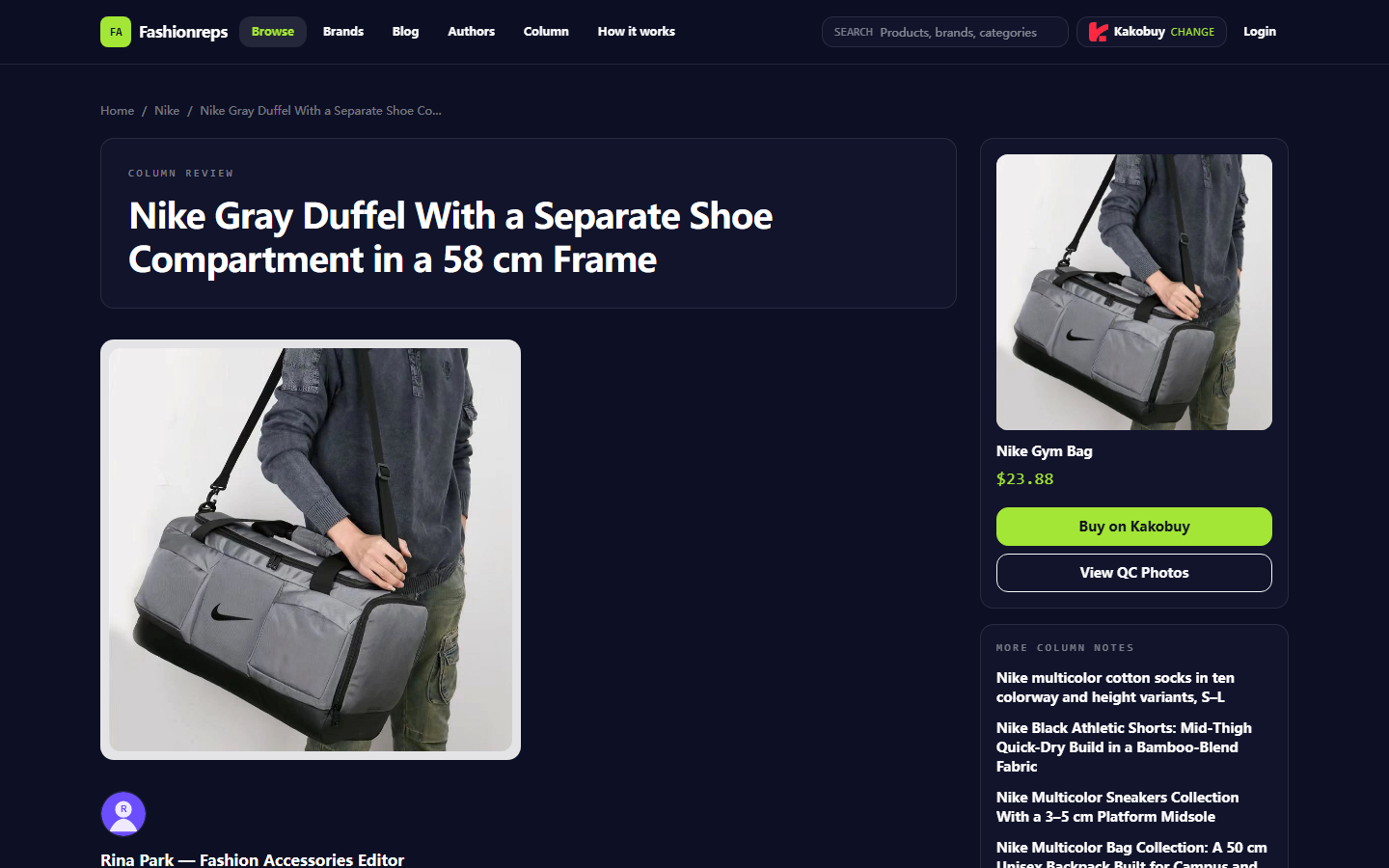
The currently verifiable page data is not a Nike sneaker product page, but a Nike gray duffel bag page. The page shows the product name as Nike Gray Duffel With a Separate Shoe Compartment in a 58 cm Frame, with dimensions 58×33×23 cm and a reference price of $23.88. This information only proves that the page has a clear Nike product listing; it cannot be used to prove the sole, upper, sizing, or all-day standing comfort of any Nike sneaker.
Therefore, this article will not transfer the duffel page's price, material, reviews, or shoe compartment information to sneaker judgments, nor will it infer cushioning, support, or durability of any specific shoe based on the brand name. The verification date for this page is October 8, 2026; price, availability, service fees, and international shipping should still be reconfirmed on the shopping agent page.
| Currently verified real product data | Applicable scope in this article | Conclusions that cannot be drawn |
|---|---|---|
| Nike gray duffel bag; 58×33×23 cm; reference price $23.88; with separate shoe compartment | Illustrates that fashion-reps pages provide product name, dimensions, reference price, and review boundaries; can serve as an example of platform information verification | Cannot prove Nike sneakers are suitable for standing all day, cannot prove sole firmness/softness, upper material, size accuracy, or wearing comfort |
This is also the key limitation of this assessment: without a qualified Nike sneaker product listing, we cannot make an actual shoe model comparison, nor give a definitive "suitable" or "not suitable" conclusion.🔎
What to Look For in Sole, Upper, and Heel Structure
When a real Nike sneaker page is available, first look at the sole appearance, upper segmentation, heel height, collar structure, and midsole shape. These can provide design clues but still do not equal long-term wearing results.
Sole images can help buyers observe whether the outsole tread is continuous, whether there is an obvious flex area in the forefoot, and whether there are signs of wear, separation, or left-right asymmetry. They cannot directly prove grip, rebound, or performance on wet surfaces, especially not replace actual feedback on different surfaces and under different body weights.
Upper images can help identify mesh, synthetic leather, textile panels, or large overlay structures. More ventilation holes may suggest breathable design, but you cannot confirm from images alone whether feet will feel stuffy during summer all-day standing. More overlays may help maintain shape but may also increase the risk of localized pressure.
The heel and collar area should be checked for obvious collapse, left-right height differences, exposed stitching, or wrinkled lining. A heel structure that looks stiff does not necessarily prove it provides proper support; one that looks soft does not prove it remains stable after long hours of standing.
Without clear sole, insole length, and detail photos, the safest statement is "there is a design clue," not "comfort is verified."
How to Pre-screen Sizing and Foot Shape Risks
All-day standing commutes are more sensitive to sizing errors. A toe box that is too narrow can cause toe compression after long standing; insufficient length can make toes constantly press against the front; a loose heel can increase friction and instability.
Before ordering, confirm the following with the seller:
- Actual insole length, not just the labeled size.
- Internal width at the widest part of the toe box.
- Any noticeable size difference between left and right shoes.
- Whether the upper has non-stretch overlays or hard decorations.
- Visible wrinkles, indentations, or asymmetry in the heel lining and collar.
- Whether the page size chart refers to foot length, insole length, or outsole length.
If the page only has a generic size chart without measured data or clear in-shoe photos, do not assume that your usual Nike size will fit this particular pair. Different lasts, versions, and seller pages can all vary.
Scenario Factors: Commute Route, Transfers, and Fall/Winter Weather
All-day standing commutes are not a single scenario. Office floors, subway platforms, outdoor sidewalks, stairs, and wet surfaces place different demands on shoes.
If your route is mainly indoor standing, upper pressure, insole condition, and heel stability may matter more than outsole tread. If you have long walks between transfers, also consider shoe weight, forefoot flex, and heel lock. If the route includes rain, leaves, or cold temperatures, static product images cannot confirm slip resistance, warmth, or waterproofing.
In fall/winter, also consider sock thickness. Shoes that fit in summer may become tight with thick socks; blindly sizing up to leave room may cause heel slippage. The correct approach is to measure foot length with your actual commute sock thickness and ask the seller for measured data for that size.🌧️
Possible Advantages and Unconfirmed Experiences
From a qualified sneaker page, buyers can usually confirm certain visible information, such as upper segmentation, sole tread, heel shape, colorways, and whether the page provides multiple angle photos. This helps filter out higher-risk pages.
But the following experiences cannot be confirmed just by brand name, marketing language, or a single main product image:
- Foot fatigue after hours of standing.
- Midsole compression and rebound changes under different body weights.
- Whether the insole slides, collapses, or causes localized pressure.
- Actual grip on wet surfaces, tile, stairs, and rough pavement.
- Upper fit for high insteps, wide forefeet, or bunions.
- Long-term wear, deformation, and lining wear.
Therefore, page reviews can only serve as context, not a substitute for clear detail photos, measured dimensions, and version confirmation of the specific product. The currently available data contains no Nike sneaker reviews, and no actual shoe measurement records to verify all-day standing comfort.
What Visible Information Should QC Photos Add
If the seller can provide QC photos, prioritize requesting content that can change your purchase decision, not just another front-facing promo shot:
- Complete side views of both left and right shoes to observe sole height, upper proportions, and obvious deformities.
- Sole front and heel views to check tread, glue overflow, separation, and left-right differences.
- Insole photo, ideally showing how length is measured.
- Tongue size tag and shoebox label to confirm size, version, and page consistency.
- Close-ups of toe box, opening, heel, and main stitching.
- Natural light photos that clearly show material and workmanship without obscuring key areas.
QC photos can only help spot visible issues; they cannot prove wearing comfort or that the shoe has passed durability or slip tests. If photos are blurry, from a single angle, cannot show both left and right shoes simultaneously, or if the seller refuses to provide key measurements, factor that uncertainty into your purchase decision.
Situations Where You Should Not Jump to Conclusions
In the following situations, do not conclude "suitable for all-day standing commutes":
- The page lacks a clear sneaker name or specific model.
- Only the brand name is shown, without clear sole, in-shoe, and size information.
- Reviews discuss other shoe models, other versions, or other sellers.
- Page images do not match the product name.
- Price, stock, size, and link status were not reconfirmed before publishing.
- Only promotional descriptions are visible, and you cannot verify the seller's actual product details.
- You have specific foot issues but hope to use a generic product page instead of professional advice.
Currently, the page falls under "product type mismatch": real data exists, but it corresponds to a Nike duffel bag, not Nike sneakers. The most reasonable action is not to write speculative shoe reviews but to wait for a qualified sneaker page, size information, and QC photos before judging.
Pre-Order Personal Checklist
You can follow this order for self-checking:
- First confirm that the page actually corresponds to the target Nike sneaker, not a bag, accessory, or other product.
- Record the page product name, version, size chart, price, and verification date.
- Ask the seller for additional photos of the sole, insole length, toe box width, and heel details.
- Write down your foot length, forefoot width, sock thickness, and daily standing hours.
- Break down your commute route into scenarios: indoor standing, long walks, stairs, wet surfaces, and waiting during transfers.
- Only treat what photos can prove as confirmed facts; record design inferences and unknown experiences separately.
- If key information is missing, treat "do not order yet" as a valid conclusion.
For the current data, the conclusion should be: It cannot be confirmed whether any Nike sneaker is suitable for all-day standing commutes. The only verifiable Nike product on the current page is a gray duffel bag with a reference price of $23.88 and dimensions 58×33×23 cm; it should not be used as evidence for a shoe. Before proceeding, you need to find the corresponding Nike sneaker page and reconfirm the product name, version, size, sole details, QC photos, price, and current availability.💡
This approach does not yield a quantifiable immediate dollar savings, but it can prevent return, shipping, and time costs from using incorrect product data, size mismatches, or treating brand impression as comfort evidence. It is suitable for commuter buyers who value evidence and are willing to wait for additional information; it is not suitable for those who must buy immediately, cannot obtain measured sizes, or need professional foot support solutions.