general
How to Verify Puma Winter Parcel Total Cost
 This verification solves a specific problem: when you are preparing to buy Puma autumn/winter shoes and clothing, and want to compare different shopping agents or logistics routes, how can you itemize the final cost under the same destination, same package weight, and same inquiry time, rather than just comparing product prices? After reading, you should be able to com

This verification solves a specific problem: when you are preparing to buy Puma autumn/winter shoes and clothing, and want to compare different shopping agents or logistics routes, how can you itemize the final cost under the same destination, same package weight, and same inquiry time, rather than just comparing product prices?
After reading, you should be able to complete a reviewable cost table and determine which amounts are confirmed and which still need package information before they can be determined. This article does not apply to comparisons that have changed products, destinations, package weights, or logistics routes, nor does it treat undisclosed shipping, taxes, or discount conditions as confirmed facts. 🧾
Specific Decision This Puma Parcel Cost Verification Answers
Conclusions on cost comparison must be based on the same set of conditions: same product or product combination, same recipient country and region, same billing weight basis, same inquiry time, and same service content.
If any one of these differs, the final amount cannot directly indicate that a particular route is cheaper. For example, one quote may include basic packaging, while another quote may already include reinforcement, shoe box removal, or insurance; one agent may display the product price, while another page may show the product price plus service fee.
Therefore, this judgment should first answer three things:
- Are you checking Puma shoes, shorts, or other autumn/winter clothing;
- Which country or region is the package being sent to, and what currency is used for recording;
- Are you comparing estimated costs, or final quotes that can already be submitted for an order.
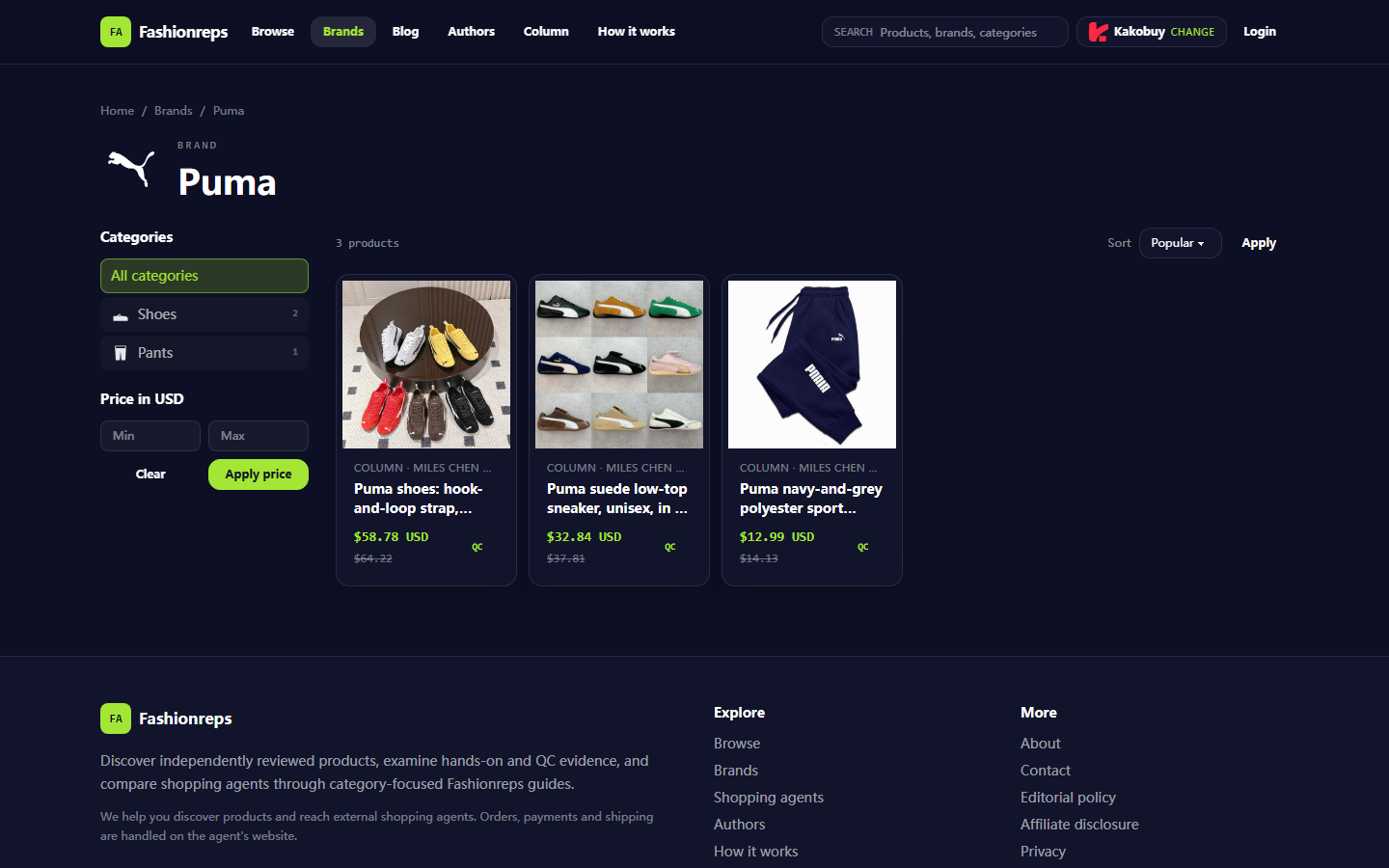
In the current data, fashion-reps' Puma brand page shows 3 product samples: a shoe with Velcro straps and emphasis on breathable structure, with a page reference price of 58.78 USD; a suede low-top casual shoe, with page reference price of 32.84 USD; and a navy blue and gray polyester sports shorts, with page reference price of 12.99 USD. These are page reference prices, not equal to the final settlement price of a specific shopping agent, and do not include subsequent services, payment, packaging, shipping, or taxes. 📦
Confirm the Product Value and Specifications of Shoes or Clothing on fashionreps Product Page
First save the product name, category, color, size range, visible material description, and reference price shown on the product page. In the product page samples, the suede low-top shoe is shown as unisex, with 16 color options, and size range 35–45; the sports shorts are shown as straight-leg, mid-rise cut, with size range S–3XL.
This information only helps you determine the comparison target and cannot replace pre-order specification verification. Shoe size, color, inventory, seller, actual payment price, and page link status may change, and you should reopen the product page to confirm before submitting an order.
The currently recordable product prices are as follows:
| Product Sample | Visible Page Information | Reference Price | Scope for Cost Table |
|---|---|---|---|
| Puma shoe with Velcro straps | Shoe, with Velcro straps and breathable structure | 58.78 USD | Only as product price sample |
| Puma suede low-top casual shoe | Unisex, 16 colors, sizes 35–45 | 32.84 USD | Only as product price sample |
| Puma navy blue and gray sports shorts | Polyester, straight-leg, mid-rise, sizes S–3XL | 12.99 USD | Only as product price sample |
The page also shows previous reference prices, but changes in reference prices alone cannot prove current inventory, discounts, or availability. Do not treat the product samples shown on the brand page as ordered products, nor claim the page reference prices as guaranteed prices.
Fix Destination, Package Weight, Dimensions, and Inquiry Time
Before comparing package costs, establish immutable verification conditions. The destination should at least record the country, state or province, city, and whether the postal code affects line quotes. Don't just write "United States" or "Europe", because different regions may correspond to different taxes, delivery restrictions, and routes.
Weight should distinguish between actual weight and billing weight. If the logistics page uses volumetric weight, the length, width, height, and volumetric weight calculation rules should also be retained. The current data does not provide specific package weight, dimensions, destination, or route quotes, so it cannot output a definite international shipping cost.
It is recommended to record the following fields:
- Product combination: e.g., one pair of shoes, or one pair of shoes plus one pair of shorts;
- Destination: country, region, city, and postal code;
- Actual weight: based on warehouse weighing records;
- Package dimensions: length, width, height, and unit;
- Billing weight: calculated according to the logistics provider's public rules;
- Inquiry time: record to the minute in local time;
- Currency: e.g., USD, CNY, or destination local currency;
- Quote status: estimate, post-warehouse review quote, or final pre-submission quote.
If the product has not yet been received in the warehouse, weight and dimensions can only serve as estimation conditions. At this point, you can compare quoting methods, but cannot claim that you already know the final logistics cost. ⏱️
Record Product Price, Service Fee, Payment Fee, and Packaging Fee Separately
Product price and package cost must be stored in separate columns. This avoids mistaking the shopping agent's service fee as shipping cost, and also helps identify whether a discount applies only to the product price or to a specific service.
The cost table should at least break down the following items:
- Product price: based on the currency and amount shown on the product page or agent settlement page;
- Shopping agent service fee: including purchasing agent, warehousing, or other explicitly listed services;
- Payment fee: including payment channel handling fee, exchange rate markup, or card network conversion cost;
- Storage and handling fee: including warehousing, photo taking, inspection, repackaging, and other explicitly charged items;
- Packaging fee: distinguish between regular packaging, reinforcement, shoe box removal, and other optional services;
- International shipping: based on the same billing weight, destination, and route quote;
- Taxes and customs clearance fees: only list separately when applicable conditions and charging party are clear;
- Discounts: record discount type, applicable scope, validity period, and usage restrictions.
When calculating, do not fill missing items as zero. Without evidence, write "pending confirmation"; otherwise, the total price will be artificially lowered.
Check Routes and Billing Weight with Verifiable Official Shipping Information
Shipping cost verification should prioritize using the official quote tools, price lists, and terms of service of the shopping agent or logistics provider. When querying, maintain consistency in product combination, destination, weight, dimensions, and additional services, and save the conditions shown on the quote page.
If the page only provides first weight and additional weight rules, clearly record the billing unit, first weight range, additional weight unit, and whether there are additional fuel, remote area, peak season, or handling fees. If the page only shows "from a certain amount", this information can only serve as a starting reference and cannot be considered a final quote.
After the warehouse has finished weighing, you should re-check:
- Whether the actual weight has changed;
- Whether volumetric weight is higher than actual weight;
- Whether the shoe box, tags, and original packaging are included in dimensions;
- Whether reinforcement, packaging removal, or combining packages was selected;
- Whether the route accepts the product category;
- Whether the quote includes final delivery, customs handling, or insurance.
The current evidence in this article does not provide official shipping numbers for a specific destination, so no specific international shipping amount is output. This avoids misusing incomplete samples or other users' quotes for your package. 🔍
How to Preserve Sources and Limitations for Exchange Rates, Taxes, and Discount Conditions
When converting between currencies, save the source of the exchange rate used, the inquiry time, and the direction of conversion. The actual conversion amount on the payment page may be affected by payment channel exchange rates, fees, or agent markups, so "product page USD price multiplied by an exchange rate" can usually only be an estimate.
Taxes cannot be assumed to be included or exempt by default. Check applicable conditions based on destination country's current rules, product category, declaration information, carrier handling, and order amount. You must declare truthfully and not reduce apparent costs through undervaluation, splitting orders to avoid taxes, or evading inspections.
Discounts need to be recorded separately:
- Whether coupons apply only to the product price;
- Whether shipping discounts are limited to specific routes, weights, or new users;
- Whether agent balance or points are withdrawable cash;
- Whether a minimum spend is required;
- Whether discounts expire after refund, cancellation, or route change.
If discount rules do not clearly state the applicable scope, mark the discount as "pending confirmation" and do not deduct it directly from the total.
Which Amounts Are Confirmed and Which Information Is Insufficient for a Conclusion
Currently confirmed are the three product reference prices and visible specifications on the fashion-reps Puma brand page. Not confirmed are your final product payment price, agent service fee, payment fee, packaging fee, storage fee, international shipping, taxes, insurance, and customs clearance fees.
Therefore, at this stage, a "cost verification at the product sample level" can be formed, but a "final total cost conclusion" cannot be formed. Only after the destination, package weight, dimensions, route, and quote time are fixed can different options be compared.
The judgment status can be saved as follows:
| Item | Current Status | Additional Information Needed Before Order Submission |
|---|---|---|
| Puma product reference price | Recorded from page sample | Reconfirm product page, inventory, size, and current settlement price |
| Product specifications | Some visible information on page | Confirm color, size, material, and seller |
| Destination | Not provided | Country, region, city, and postal code |
| Actual weight and dimensions | Not provided | Warehouse weighing and package measurement |
| Agent service fee and payment fee | Not provided | Official fee details of the agent |
| Packaging and combining fees | Not provided | Selected packaging service and charging rules |
| International shipping | Not provided | Official quote for the same billing weight and destination |
| Taxes and customs clearance | Not provided | Destination country rules and carrier instructions |
| Exchange rate and discounts | Not provided | Source, inquiry time, and applicable conditions |
Puma Parcel Cost Verification Table and Pre-Order Actions
Before submitting an order, copy the same product combination into each option to be compared, changing only the agent or logistics route, and not changing the destination, billing weight, or service content. For each option, keep quote screenshots or page records, and note the inquiry time and currency.
The total cost can be calculated using the following logic:
Product price + service fee + payment fee + storage and handling fee + packaging fee + international shipping + applicable taxes and customs clearance fees − confirmed available discounts = estimated total cost.
If an item is unknown, keep "pending confirmation" instead of writing zero. When making the final comparison, record both the total amount and the risks: whether the quote will change due to volumetric weight changes, whether the route restricts product categories, whether taxes are borne by the recipient, and what the compensation limit is for lost or damaged packages.
Combining packages may reduce duplicate first weight or some handling costs, but may also increase volumetric weight, single package value, and one-time loss risk. Splitting packages may increase fixed costs but may be suitable for orders with route restrictions, weight limits, or different arrival times. Without actual weight, dimensions, and route quotes, you cannot claim which option is definitely cheaper.
This verification method is suitable for buyers who need to control budget before submitting an order, compare multiple agent quotes, or want to keep complete records. It is not recommended to decide based solely on page reference prices when product specifications, destination, billing weight, tax bearer, or route restrictions are unclear. The saving now is not an unverified fixed amount, but the reduction of unexpected expenses caused by missing service fees, payment fees, packaging fees, taxes, or volumetric weight through itemized verification.