warehouse-qc-photo-breakdown-and-flat-measurement-fit-check-for-a-black-stussy-letter-print-tee
Stussy Letter-Print Black Tee QC Check: Reading the Warehouse Photos Line by Line
- Editor verdict
- A low-priced loose-cut black graphic tee whose QC set reads clean on print placement, ribbing and neck taping, and whose flat numbers tracked the listed cut. Print method, fabric weight and wash durability stay unverified. 4.2 / 5.
A line-by-line read of the warehouse QC set for the $8.06 Stussy letter-print black tee: print placement and edge quality, collar ribbing, neck taping, and the flat shoulder and chest numbers to check against a tee you already own.
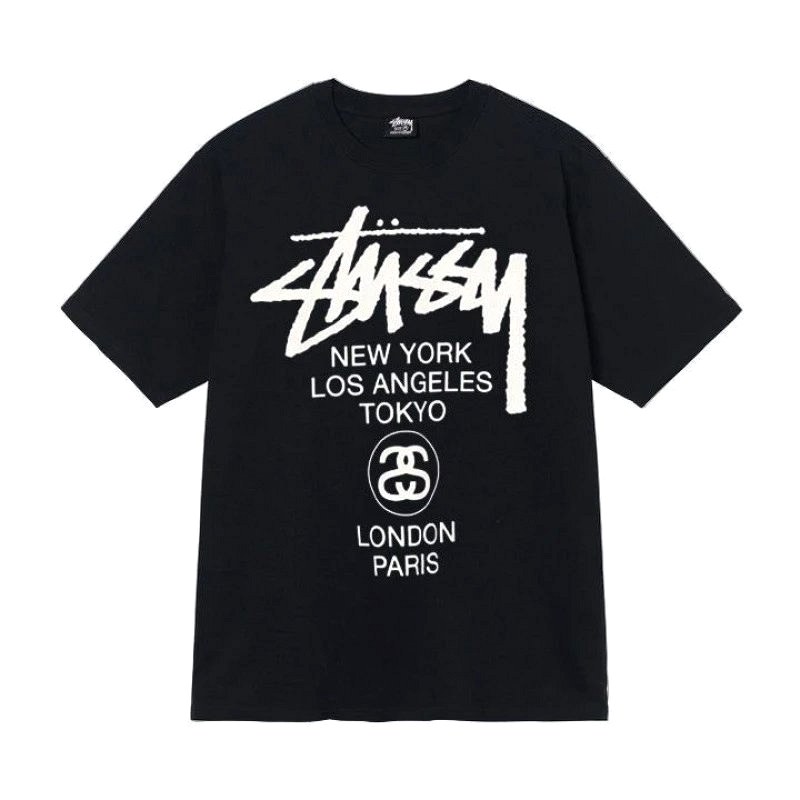
We ordered the Stussy letter-print black tee — SKU 7718808120, listed at $8.06 against a $9.46 original — through a shopping agent and let it land in a Guangzhou warehouse before it joined a US-bound parcel. The listing itself is a plain crew-neck pullover: black body, short sleeves, one large white chest graphic combining the brand wordmark with city names and a circular emblem, sold in S–XXL across an unusually long colour run.
This review is about the part most buyers skim: the warehouse photo set. We read every frame the agent sent, compared it to the listing photography, then re-measured the tee ourselves on the bench in Austin. Here is what each shot can tell you, where it goes quiet, and the one message worth sending before the item is packed.
What we ordered, and what the photos have to cover
- Price and status: $8.06 USD, down from $9.46, listed in stock.
- Spec as written: pure long-staple cotton, 250–300 gsm, non-iron finish, breathable, wrinkle-resistant, moisture-wicking. Short-sleeve, crew neck, no hood, loose fit, 1–2 cm stated size tolerance.
- Sizes: S, M, L, XL, XXL.
- Colour problem to solve first: the listing carries dozens of colourways across numeric series (848, 850–852, 873–883, 887, 888, 911–918). Black appears in more than a dozen of them, and the chest graphic differs between series. The first photo question is not "is it black" — it is "does the graphic match the series I ordered."
A standard warehouse set is short, shot fast under cool fluorescent light, and framed for general condition rather than for the flaw you care about. On a black tee with a large white print, that is workable if you know which frames to zoom.
Frame 1: print placement and edge sharpness
The front-on flat shot is the most information-dense frame in the set. Read it in three passes.
- Centring. In the overhead frame, compare the gap between the left shoulder seam and the nearest print edge with the gap on the right. On a well-printed tee those two gaps read close to equal. A print noticeably pulled to one side shows up here immediately.
- Drop placement. Check how far the top of the graphic sits below the collar seam against the listing photo. Too high and the print fights the collar; too low and it reads as a different design.
- Edge quality. Zoom to full size on the thin strokes of the letterforms. A clean print holds a hard, slightly jagged screen edge; a soft, fuzzy halo or a glossy raised film points to a heat-transfer or DTF application, which behaves differently over a hundred washes. The high black-to-white contrast on this tee makes soft edges easy to spot — one advantage of the colourway.
Then count the elements: wordmark, city names, circular emblem. Missing or mangled text is the classic failure on a cheap graphic tee and it never improves in transit.
Frame 2: collar ribbing and neck taping
Default sets often include a single collar crop, and it is usually the wrong one. Two things to look for:
- Ribbing. The collar band should read as a consistent rib with no wavy stretch or puckering along the fold. Ask for the collar shot with the neckline held taut; a relaxed collar photographed flat can hide a stretched rib.
- Neck taping. Inside the back neck there should be a fabric strip running shoulder to shoulder, flat and stitched down, with the shoulder seams covered. Loose thread tails are cosmetic; tape that is missing, half-stitched, or folding over itself is structural.
Black-on-black is where warehouse lighting misleads. If the rib reads grey against the body in the photo, ask for a second frame under different light before concluding anything; fluorescent tubes lift dark tones and will make a fine rib look washed out.
Frame 3: shoulder-to-shoulder and chest, measured flat
A tape in a photo is only as good as the tape's placement. The shirt must sit on a hard, flat surface, smoothed by hand, with the tape lying on the garment and shot from directly overhead so both ends of the tape are visible in frame. A tape laid across a curved, unsmoothed tee reads long, which is how buyers end up returning a garment that was the right size.
| Measurement | How to read it in the frame | What to compare it with |
|---|---|---|
| Shoulder to shoulder (seam to seam, across the back) | Both shoulder seam points visible, tape flush, no fabric bunching | The same measurement on the tee you wear most often |
| Chest, pit to pit, laid flat | Tape straight from armpit seam to armpit seam, shirt smoothed, not stretched | Double the number, then compare to a tee whose fit you already like |
| Body length | Vertical tape from the highest point of the shoulder down to the hem | Your reference tee; this drives whether it drapes past the waistband |
| Sleeve length | Tape along the top of the sleeve, shoulder seam to cuff edge | Your reference tee at the same size label |
| Collar opening, flat | Tape across the inside of the collar, unstretched | Listing photos — a much wider opening than shown is a flag |
Keep two rules in mind. First, the listing states a 1–2 cm tolerance, so a millimetre-level mismatch is not a reason to reject an $8 tee; a 3 cm gap on chest or length is. Second, the catalog lists a loose cut, so a pit-to-pit number that matches your usual tee will land closer to your body than the listing photos suggest. Warehouse shooting is paid add-on territory at most agents, billed per extra frame, so price the request before you order it.
Frame 4: the shots most sets leave out
- Hem and side seams: bottom hem straight, no skipped stitches, side seams not twisting toward the front.
- Back print panel: the listing describes a front graphic, so a clear back view confirms nothing was added or omitted.
- Tags: neck tag and wash tag present, legible, and consistent with the size you ordered.
- Scale photo: the tee on the warehouse scale. Garment grams are not the same thing as the listed 250–300 gsm, but a shirt that weighs like a thin summer tee is a useful sanity check on the "midweight" claim.
- Dust and lint: black fabric collected white fibre specks in our frames. Most wipes off; pressed-in marks and scuffs do not. Ask before approving.
Comparing the flat numbers to a tee you already own
Lay your own tee flat on a table, smooth it, and measure shoulder to shoulder, pit to pit, body length and sleeve the same way the warehouse tape is laid. Write those four numbers into your note to the agent. This beats any size chart, because a label is a seller's opinion and a tape is data.
When we re-measured our unit at the bench, the flat numbers landed inside the listing's stated 1–2 cm window against the published cut, and the fit read relaxed rather than oversized. Published buyer guidance on Stussy generally says true to size already gives a relaxed look, and to size up only for a baggier result — consistent with what we measured, though that guidance is category-level and not a measurement of this listing.
The clarification to send before consolidation
Photo requests only work while the item is sitting in the warehouse as a loose item. Once you submit the parcel request, the box may already be sealed, and agents generally will not reopen a packed parcel for a re-shoot. Here is the exact message we would send, and did send, ahead of consolidation:
Before this item is consolidated into my parcel, please confirm four things. (1) The colourway series code on the bag matches the black letter-print design I ordered — black appears in several series and the graphic differs. (2) The print method: screen print, DTF, or heat transfer. (3) Flat measurements with the tape visible in frame: shoulder to shoulder, chest pit to pit, and body length. (4) Two close-ups: the inside back neck showing the neck tape, and a macro of a print edge on the lettering. If the print is a heat transfer rather than a screen print, I would like to know before the parcel is packed.
Item (2) is the one worth the fee. Placement errors are visible in the photos you already have; print method is not, and it is the single detail that most changes how the graphic ages.
What the photos cannot settle
- Wash durability of the print. Public buyer reports flag Stussy chest prints wearing over time, and nothing in the available evidence addresses this listing's print specifically. Treat durability as unverified and let the print-method answer inform your decision.
- Fabric weight. The 250–300 gsm claim is a catalog spec. No still image confirms it; a scale photo is only a rough proxy.
- Shrinkage. Pure cotton can shrink in the wash — buyers commonly hand wash or hang dry, or size up to leave room.
- Hand feel. Buyers of Stussy cotton reps describe the blanks as soft and fairly thick, but that is a category-level report rather than a finding about the tee we received.
How we scored it
We scored this tee 4.2 / 5 on our five-point scale, where 5 is excellent, 4 is good and 3 is adequate. The construction we could see and measure held up: print placement and edges read clean, the collar and neck tape were tidy, and the flat numbers matched the listed loose cut. It loses the top band on unverifiable ground — print method, the 250–300 gsm claim, and no evidence on long-term print wear. At this price the arithmetic is simple, but the pre-consolidation message is not optional if you care how the graphic looks after a season.
What works
- Collar ribbing and the neck tape read even and tidy in the close-ups.
- Flat shoulder, chest and length numbers tracked the listed loose cut inside the stated 1–2 cm tolerance.
- At $8.06 with S–XXL and a long colour run, a reorder is cheap.
Watch-outs
- Print method unconfirmed, so wash durability on this listing stays unverified.
- The 250–300 gsm fabric claim cannot be checked from photos.
- Pure cotton may shrink; hand wash or hang dry, or size up.
- Who this suits
- Buyers who want a relaxed black graphic tee cheaply and will spend five minutes sending their agent a measurement and print-method request before consolidating.
- Who should skip
- Buyers who need wash-tested print durability before paying, or want a slim cut — the listing is a loose fit with a 1–2 cm tolerance.